The Beasts
overview
In the Old Testament prophetic Book of Daniel, King Nebuchadnezzar was described to have seen a large statue in a dream. Only the Jewish prophet Daniel was able to interpret the dream. Later, Daniel himself had a dream about four beasts; his dream paralleled Nebuchadnezzar’s dream. The parts of the statue, as well as the beasts, were found to represent kingdoms or nations upon the earth—the first of which existed at the time, and the remainder of which, eventually, would arise.
In the New Testament prophetic Book of Revelation, John described two other beasts which would arise. These latter two beasts will be prominent in the future of this world, near the “end of the age,” perhaps relatively soon. Their identities probably will be surprising to most when they are revealed.
The beasts also represent kingdoms or nations which have had, or will have, domination over the nation of Israel. In addition, there are beasts who are representative of supernatural spiritual entities (also known as “princes”) and human leaders (also known as “kings”) who rule over nations or conglomerates of nations around the world.
The prophesied righteous “seed” has passed through Abraham and the nation of Israel/Judah to the ultimate Messiah, Jesus Christ
Nebuchadnezzar’s statue
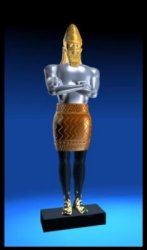 When King Nebuchadnezzar of Babylon had a dream
Historically, Babylon was overthrown by the Medo-Persian Empire, which was overthrown by the Grecian Empire, which was overthrown by the Roman Empire. The top four sections of the statue were represented as follows:
Head of Gold
Chest & Arms of Silver
Belly & Thighs of Bronze
Legs of Iron Babylon
Medo-Persia
Greece
Rome606–539 B.C.
539–331 B.C.
331–169 B.C.
169 B.C.–476 A.D.
Interestingly, as the metals progress from top to bottom, they become less valuable but also harder and more dense. Perhaps this is an indication that the kingdoms would progress into more evil and inflexible empires, becoming more ruthless and cruel to the people controlled by them.
Loosely speaking, the feet of the statue might be considered to be the Ottoman Empire (1299–1923 A.D.). This was an Islamic transitional stage between the Roman Empire and a present-day union of many nations.
The final “empire” or “kingdom”—a merger of the 2 feet and 10 toes of the statue, as an outgrowth of the legs of iron—will be one where “the people will be a mixture and will not remain united, any more than iron mixes with clay”
In the dream, all the segments of the statue were “broken to pieces at the same time” by a rock, which then “became a huge mountain and filled the whole earth”
Daniel’s four beasts
Daniel later had a dream about four great beasts
- a lion with wings like an eagle,
- a bear raised up on one side with three ribs between its teeth,
- a leopard with wings like a bird and four heads, and
- a terrifying, powerful beast with large iron teeth and ten horns.
While Daniel was thinking about the ten horns, another little horn, with eyes like a man, came up among them, and “three of the first horns were uprooted before it” (7:8a).
These beasts exactly paralleled the sections of the statue in Nebuchadnezzar’s dream, and the ten horns of the final beast were analogous to the ten toes of the statue. The iron legs of the statue
The obvious prophetic question is this: What are the ten horns of Daniel’s final beast, which are equivalent to the ten toes of Nebuchadnezzar’s statue? That is, if the Roman Empire ultimately fragmented into ten major parts, what are these parts? And what does the little horn, arising among them, represent?
Before addressing these questions, we first need to look at, and carefully to analyze,
- the seven heads of Daniel’s four beasts
(Daniel 7:2-7), - the four heads of Daniel’s third beast (7:6),
- Daniel’s fourth beast
(7:7), and- John’s beast out of the sea
(Revelation 13:1b-8), having ten horns and seven heads (13:1c), as well as other similarities to Daniel’s four beasts.
the seven heads of Daniel’s four beasts
It is important to look more closely at the collective number of heads of Daniel’s four beasts
In a later vision
History tells us that Alexander the Great was the “prominent horn”
- Greece (ruled by Cassander),
- Asia Minor (ruled by Lysimachus), composed mostly of present-day Turkey,
- Egypt (ruled by Ptolemy I = Ptolemy Soter), and
- Mesopotamia and Syria (ruled by Seleucus I Nicator).
Therefore, the four beasts
- 1st Beast (7:4)
- 2nd Beast (7:5)
- 3rd Beast (7:6)
- 4th Beast (7:7)
Babylonian Empire
Medo-Persian Empire
Grecian Empire
Roman Empire
Total1 head
1 head
4 heads
1 head
7 heads
the stern-faced king
Daniel was told about a “stern-faced king”
Another thing the wicked man in the prophecy was predicted to do was to “take his stand against the Prince of princes”
There also is another ruler to come: the Antichrist who, presumably, will fulfill the prophecy about the “stern-faced king” as well
Furthermore, in the dream of Nebuchadnezzar’s statue, which Daniel interpreted, the statue represented kingdoms or empires that have spanned several millennia. At the end of the age, the entire anti-God system in the world—which is composed of remnants of all of these pagan kingdoms, including the Grecian empire—will be “broken to pieces at the same time” by a “rock”
the four heads of Daniel’s third beast
As stated in the previous section (the seven heads of Daniel’s four beasts), upon the death of Alexander the Great (who was described as a “large horn”), four “horns” or kingdoms emerged from the Grecian Empire
- Egypt,
- Syria,
- Greece, and
- Turkey.
In some form or another, all of these have had dominion over and/or a direct affect upon Israel, God’s chosen land. The Israelites were in bondage for hundreds of years in Egypt, until Moses led them out
Daniel’s fourth beast
The fourth beast that Daniel saw in his dream/vision
The western “leg” of the Roman Empire fragmented into numerous regions, populated by various peoples. Over time, the Germanic tribes set up new kingdoms: the Visigoths in Spain, the Franks in Gaul (which eventually became France and Germany), the Angles and Saxons in Britain, and the Lombards in Italy. Through countless changes over many centuries, the western Roman Empire has evolved into most of today’s European Union (EU). By and large, the overwhelmingly dominant power of today’s western “leg” of the old Roman Empire lies with five nations, which I believe may be considered to be the 5 “toes” on one foot of Nebuchadnezzar’s statue:
- Britain,
- France,
- Germany,
- Italy, and
- Spain.
In 293 A.D., the Roman Emperor Diocletian shifted the center of the Roman Empire eastward, to Byzantium. The eastern “leg” of the empire became known as the Byzantine Empire or the Eastern Roman Empire. In 326, Constantine renamed Byzantium as Constantinopolis. Today, this is Istanbul, Turkey.
Over centuries, the Byzantine Empire also underwent many changes. Finally, in 1453, the Osmanli, a nomadic tribe in Turkey, conquered the Byzantine capital, Constantinople. Thus began the Ottoman Empire, named after the first ruler, Osman. The great Ottoman Empire, essentially, was a continuance of the Byzantine or eastern “leg” of the Roman Empire, and it lasted for almost six centuries, until 1923. The Ottoman Turks headed one of the greatest imperial powers in history. The Ottoman Empire was a theocracy, with the sultans dedicated to the advancement of the Sunni branch of Islam through military means.
With the decline of the Ottoman Empire, four dominant states arose: Greece, Turkey, Syria, and Egypt—which were restorations of the four heads of Daniel’s third beast, the Grecian Empire. The dominant power of today’s eastern “leg” of the old Roman Empire seems to lie with the following nations, which may be considered to be the 5 “toes” on the other foot of Nebuchadnezzar’s statue:
- Egypt,
- Greece,
- Iran/Iraq,
- Syria, and
- Turkey.
John’s beast out of the sea
John described a great beast
The ancient prophet Jeremiah referred to Babylon as a “destroying mountain”
Now, it has been shown how Daniel’s four beasts
The “head” or kingdom which was in power at the time John lived and wrote (described by him as “one is”—17:10) was:
- Egypt,
- Assyria,
- Babylon,
- Medo-Persia, and
- Greece.
The “head” or kingdom which was yet to come (described by John as the one which “has not yet come” but which “must remain for a little while” when it did—17:10) was:
- Rome.
- the Ottoman Empire (an expansion of Turkey).
Note, from the seven heads of Daniel’s four beasts section, that four of the kingdoms—Greece, Turkey, Egypt, and Syria (Assyria)—were the sub-kingdoms into which the Grecian Empire was divided. Therefore, whichever way it is viewed, I believe the seven “heads” seen by John
In
- Egypt,
- Assyria (modern-day Syria),
- Babylon (modern-day Iraq),
- Medo-Persia (modern-day Iran),
- Greece,
- Rome (modern-day Italy and/or the Vatican), and
- the Ottoman Empire (modern-day Turkey).
ten toes and horns
Pertaining to the ten toes of Nebuchadnezzar’s statue
- Britain,
- France,
- Germany,
- Italy,
- Spain,
- Egypt,
- Greece,
- Iran/Iraq,
- Syria, and
- Turkey.
 I tend to lean toward the possibility that at, or soon after, the midpoint of the 70th Week, when the “man of lawlessness” (Antichrist) is “revealed”
 The illustration at the left is another possibility of how the kingdoms in a global government might look. In such an assemblage of regions or kingdoms, presumably each one would have a sovereign ruler. The collection of these leaders might be the “kings of the earth”
Some have pointed out the possibility that the ten kingdoms might be contained in the following biblical passage:
See how your enemies are astir, how your foes rear their heads. With cunning they conspire against your people; they plot against those you cherish. “Come,” they say, “let us destroy them as a nation, that the name of Israel be remembered no more.” With one mind they plot together; they form an alliance against you—the tents of Edom and the Ishmaelites, of Moab and the Hagrites, Gebal, Ammon and Amalek, Philistia, with the people of Tyre. Even Assyria has joined them to lend strength to the descendants of Lot(Psalm 83:2-8).
Another theory is that the European Union (EU) is the revived, and revised, modern-day Roman Empire. The two main problems with this theory are that there now are many more than ten members of the EU. Plus, these nations comprise only the western “leg” of the Roman Empire, thus completely ignoring the eastern “leg.”
Yet another theory proposes that the great Roman Empire was fragmented into ten (10) geographical areas with the following ten peoples, seven (7) of whom eventually became most of the Europe that we know today:
Anglosaxons (English)
Franks (French)
Suevi (Portuguese)
Visigoths (Spanish)
Burgundians (Swiss) Alamanni (Germans)
Lombards (Italians)
Ostrogoths(gone after 553 A.D.)
Heruli(gone after 493 A.D.)
Vandals(gone after 534 A.D.)
This theory says that three of the above—the Ostrogoths, the Heruli, and the Vandals—were wiped out or “uprooted”
There are at least two problems with this theory:
- There were other important groups of people within the Roman Empire besides these ten (such as the Allemanni, the Suevi, the Bavarians, the Moors, and others).
- These groups of people composed only the western portion of the Roman Empire, while the eastern portion of the Roman Empire (the other iron “leg” of Nebuchadnezzar’s statue) is completely ignored. It makes a great deal more sense to consider 5 significant “toes” on each of the two feet.
the eleventh horn: Antichrist
After describing the fourth beast and its ten horns
It would seem that the seven horns that were not uprooted by the little (eleventh) horn
The five (of seven) kings that have fallen in the past most likely are Egypt, Assyria, Babylon, Medo-Persia and Greece (as shown in the John’s beast out of the sea section), all of which are nations again. Evidently, their end-time leaders or “kings” are five of the ten “horns” who, for a short time, will be kings along with the beast (Antichrist); they will give their power and authority to him and will make war against Jesus, the Lamb
There have been countless attempts to identify whom the Antichrist is or will be. Most of the presumed identifications have resulted from illogical assumptions or fantastic imaginings. I feel that it may be possible to be certain of the Antichrist’s identity at, or soon after, the middle of the 70th Week, when the “man of lawlessness” (Antichrist) is “revealed”
the Assyrian
Many prophecies in the Bible, particularly in the Old Testament, have more than one instance of fulfillment. Often, the last—and most intense—occurrence is yet in the future, at the “end of the age,” especially during the periods known as the Great Tribulation and the Day of Vengeance. An example of this may be the use of the term “the Assyrian” by the prophet Isaiah
The same passage
Yet, following the Battle of Armageddon, the Antichrist will be “thrown alive into the fiery lake of burning sulfur”
I will crush the Assyrian in my land [Israel]; on my mountains I will trample him down. His yoke will be taken from my people, and his burden removed from their shouldersThe latter sounds like what will happen to Gog and Magog, as described by Ezekiel:(Isaiah 14:25).
On the mountains of Israel you will fall, you and all your troops and the nations with you. ... On that day I will give Gog a burial place in Israel, in the valley of those who travel east toward the Sea. It will block the way of travelers, because Gog and all his hordes will be buried there. So it will be called the Valley of Hamon GogFurthermore, Isaiah wrote that the following will apply to “the Assyrian”:(Ezekiel 39:4,11).
Woe to the Assyrian, the rod of my anger, in whose hand is the club of my wrath! I send him against a godless nation, I dispatch him against a people who anger me, to seize loot and snatch plunder, and to trample them down like mud in the streets. ... For he says: “By the strength of my hand I have done this, and by my wisdom, because I have understanding. I removed the boundaries of nations, I plundered their treasures; like a mighty one I subdued their kings”Similarly, this is what Ezekiel wrote about what the Israelites would do, after being plundered and looted by Gog:(Isaiah 10:5,6,13).
And they will plunder those who plundered them and loot those who looted them, declares the Sovereign LORD(Ezekiel 39:10).
In addition, John wrote about how the beast (Antichrist), and the ten kings who follow him, will come specifically against the Lamb
It seems evident, from
Conceivably, then, the Antichrist could rule over the western “foot,” and Gog (the Assyrian) over the eastern “foot,” of the revived Roman Empire
Both of the main branches of Islam, Sunni and Shi’a, seek the absolute destruction of Israel. Perhaps the Assyrian or Gog will be al-Mahdi, the coming redeemer of Islam. Thus, I believe it is plausible to consider that the forces of the Antichrist will be one branch of Islam and the forces of Gog/Magog another branch, both vying to capture the ultimate “prize”: Israel (see Gog vs. Antichrist).
Looking at the map below, we should keep in mind the major Arab uprisings within many nations during 2011 and 2012. These very well could result in the radical Islamization of many formerly moderate Islamic nations, such as Libya, Syria, Egypt, Algeria, and others.
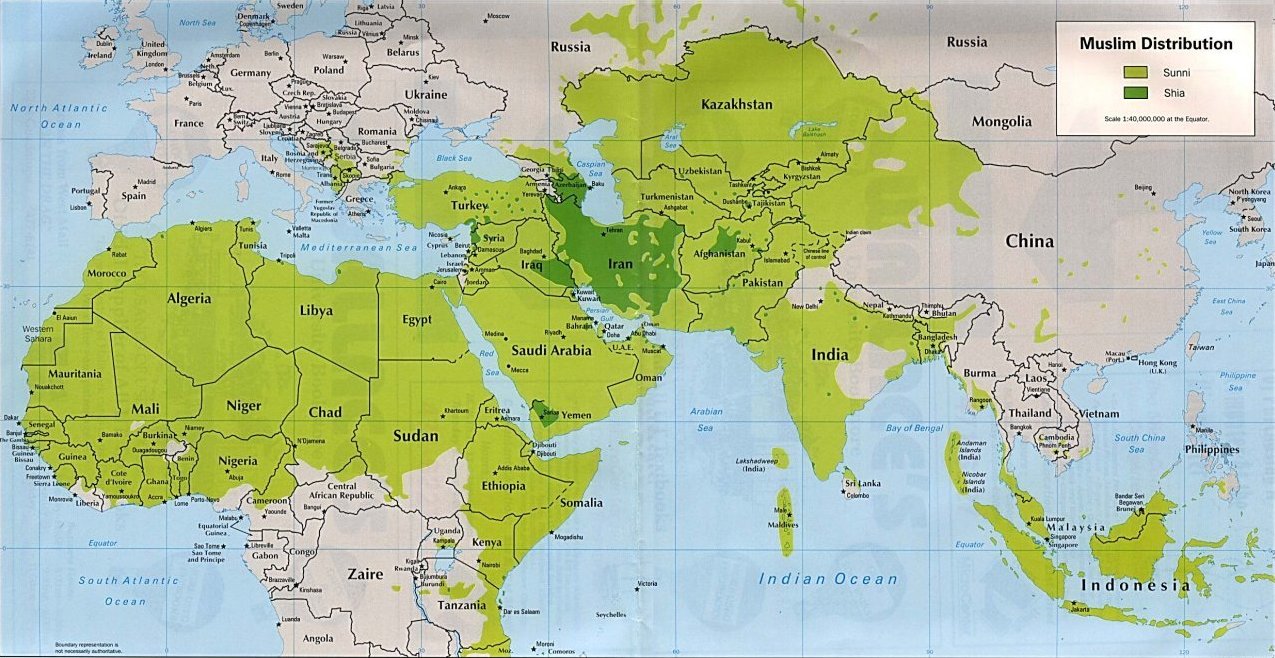
See Larger View
Radical Islam has set out to take over the entire world, and the majority of the eastern portion of the former Roman Empire already is Islamic. Islam presently has great influence over many nations in the EU, due to a great deal of immigration over many years, and is the fastest growing forced religion in Europe (see “Religion of Peace” Demonstration), if not in the entire world.
the Pope and Catholicism
Antichrist spirit
Another theory, espoused primarily by the Seventh Day Adventist Church, is that the beast will be united under Catholicism. I personally do not subscribe to this belief. However, I will present it here, for various reasons, one of which is that I do accept the premise that the Sabbath is Saturday (as advocated by Seventh Day Adventists), not Sunday.
The belief is that the “little horn”
One interpretation is that the antichrist spirit would pass through some or all of the papacy line. There are presumed evidences pointing to the latter. For one thing, the primary motives of the Popes during the Crusades of the Middle Ages were for political and territorial domination and for the expansion of their rule in the world, not for the spreading of the Gospel of Jesus Christ. Rampant persecution was a part of this
blasphemy
John described the beast as uttering “proud words and blasphemies”
Thus, acting in the role of Christ or God (such as in claiming to forgive sins), and being portrayed or portraying oneself as equal to Christ or God, fulfill the definition of “blasphemy”—traits which some attribute to the Catholic clergy and the Pope.
change times and laws
One of the things Daniel indicated about this personification of the “eleventh horn” is that he would “try to change the set times and the laws”
Pertaining to the changing of laws, the Ten Commandments are accepted widely by Christians (both Protestants and Catholics alike) as irrevocable laws for mankind, written in stone by the hand of God and given to Moses to pass onto the Israelites. However, the list of Ten Commandments differs for Protestants and Catholics.
Protestants see Commandment #2
- #9: forbidding the coveting of your neighbor’s wife, as distinguished from
- #10: forbidding the coveting of your neighbor’s possessions or goods.
Some believe that, due to Jesus’ sacrifice on the cross, Christians no longer are bound by the laws defined in the Old Testament. Although this is true for ceremonial and ritual laws, it is not true for the Ten Commandments. Here are brief commentaries on the subject by Billy Graham and John Wesley:
God is unchanging. His specific laws (the Ten Commandments) are unchangeable, and they are separate and distinct from the laws of Moses:
the Sabbath
Someone’s “official seal” contains these three items:
- the person’s name,
- the person’s title or office, and
- the territory or area over which the person has jurisdiction or rule.
Now, consider specifically Commandment #4, concerning the observance of the Sabbath
- the Lord, or the Lord your God (YWVH),
- Creator or Maker, and
- the heavens and the earth, the sea, and all that is in them.
This commandment is the only commandment in which is contained God’s “seal” or “mark.” It can be argued that this is what gives the Ten Commandments validity and authority.
The “seventh day” or last day of the week is Saturday. In numerous languages, the word “Saturday” incorporates into it the word “Sabbath” or some form of it:
The tradition of worshipping on Sunday in the Church (both Catholic and Protestant) has been widely accepted for centuries, mostly because Jesus was resurrected on the first day of the week
Nevertheless, there is no clear basis in Scripture for worshipping on a Sunday rather than on a Saturday, the latter clearly being the Sabbath. Worshipping on a Sunday merely is an ongoing tradition of the Church, both Catholic and Protestant.
Jesus said that He was the “Lord of the Sabbath” and then went into a synagogue
Practically speaking, God should be worshipped and honored every day of the week. However, one day of the week should be set aside, where no regular work is done and where special focus is given to communion and personal relationship with God and study of His Word. The Scriptures indicate that this Sabbath day
final Popes
In the 12th Century, St. Malachy O’Morgair, the Archbishop of Armagh, Ireland, had a prophetic vision of the 112 popes following Pope Celestine II, who died in 1144. The descriptions of all 112 Popes are here: St. Malachy's Prophecy of the Final 112 Popes. These are St. Malachy’s names (in italics) for the final five Popes:
- Paul VI (1963-1978): Flos florum, which means “flower of flowers.” Paul VI’s coat of arms bore the image of three lilies.
- John Paul I (1978): De medietate Lunae, meaning “of the half of the moon.” John Paul reigned for about a month—from half a moon to the next half moon.
- John Paul II (1978-2005): De labore Solis, or “from the labor of the sun.” John Paul II was born during a partial solar eclipse (May 18, 1920). There also was a rare “hybrid” eclipse on the day of his funeral (April 8, 2005).
- Benedict XVI (2005-2013): Gloria Olivæ, or “glory of the olive.” St. Benedict himself prophesied that before the end of the age, his Order, known also as the Olivetans, triumphantly would lead the Catholic Church in its fight against evil. This pope was a conservative peacemaker, and the olive branch is a symbol of peace.
Francis (2013-????): Petrus Romanus, or “Peter of Rome.” It was predicted that this pope would reign during a time of extreme persecution of the Church. He would feed the sheep through many tribulations, at the end of which the city of seven hills (seemingly, Rome) would be destroyed, and then the formidable Judge will judge His people.
Thus, Pope Francis very well could be the final pope. His papacy began at age 76 on March 13, 2013. He was born in Buenos Aires, Argentina, so one might wonder how he could be Petrus Romanus or “Peter of Rome.” In fact Pope Francis (Jorge Mario Bergoglio) is of Italian descent because his father, Mario José Bergoglio, was an Italian immigrant to Argentina.
Also, Pope Francis named himself after St. Francis of Assisi, who was an Italian or Roman priest. Assisi’s original name was Giovanni di Pietro (Peter) di Bernardone or “Peter the Roman.”
Furthermore, Pope Francis has reaffirmed the authority of the Roman Pontiff over the Church and emphasized the supremacy of the Roman Catholic Faith and the Roman Catholic Church above all other religions and denominations, as well as its authority over all Christians and all peoples of the world.
combination of religions
Some believe that an end-time combination of Islam and Catholicism is a possibility for the domination of world power. It is pointed out that Catholicism already has incorporated certain aspects of ancient Babylon into its system of worship, such as
Radical Islam, and its holy book the Qur´an, clearly are anti-Semitic. Due to the somewhat anti-Semitic stance of the Catholic Church at times, it has been proposed that an alliance between the Islamic nations of the Middle East and the Catholic nations of Europe is a possibility.
- making Sunday the day of worship (as it was in ancient times for the sun god, Sol), rather than the Sabbath, Saturday, as was stipulated by Commandment #4
(Exodus 20:8-11); - considering idols and images as objects of veneration and worship;
- “goddess worship” (with Mary often thought of as the Queen of Heaven); and
- requiring the priesthood to be unmarried.
A potential scenario has the first beast
It has been said that the final Pope will be a “defector” from the Christian faith. Pope John Paul II (1920–2005) and Pope Benedict XVI (2005-2013) adhered strongly to Church doctrine and dogma.
As for Pope Francis, in April 2020, he stated that he is not the vicar of Christ or successor of the Apostles. Many Catholics considered this to be “theological barbarism.” One of his messages is that all religions and all faiths lead to the same God, which is not true. Views like this are preparing the way for a one-world religion, and the pope could become the head of that.
Conservative critics often cite the pope’s views on poverty and income inequality to defend the argument that he is “pushing a liberal agenda.” In fact, many liberals have welcomed the idea of the pope’s humanistic, nonrestrictive and flexible views.

Ted’s Bible Commentaries
and Other Links

Comments or questions? Email Me.

Copyright © 2004– by Ted M. Montgomery, O.D. Most rights reserved.
THE HOLY BIBLE, NEW INTERNATIONAL VERSION®, NIV®
Copyright © 1973, 1978, 1984, 2011 by Biblica, Inc.®
Used by permission. All rights reserved worldwide.